
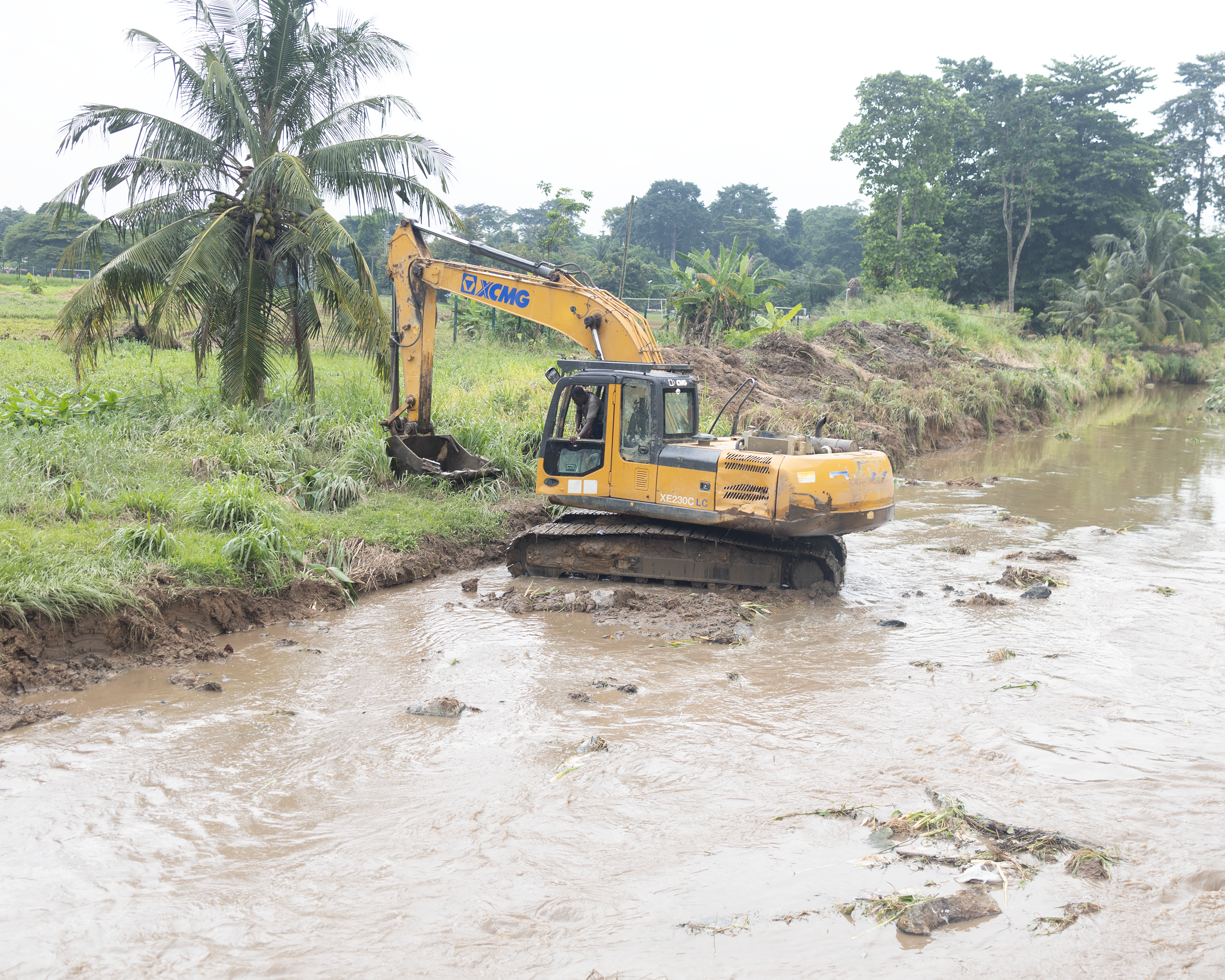
Excavators have begun dredging sections of the Wewe River at the Kwame Nkrumah University of Science and Technology, Kumasi (KNUST), as authorities work to reclaim drainage capacity and strengthen the University's long-term flood resilience.
The exercise, being undertaken through a collaboration between KNUST, the Ashanti Regional Coordinating Council and the Ashanti Regional Office of the National Disaster Management Organisation (NADMO), follows an assessment that identified river overflow, silted channels and restrictions within drainage pathways as contributing factors to the recent incident.
Deputy Ashanti Regional Director of NADMO, Mr. Charles Oppong, said investigations established that heavy rainfall caused the river to exceed its banks while existing obstructions limited the movement of water through the system.
"We are here to assess the causes of the flooding that occurred, and we have established that it resulted from a river overflowing its banks following the recent rains," he said.
According to Mr. Oppong, investigations also revealed that some drainage pathways had become obstructed over time, limiting the movement of water during periods of intense rainfall.
"The drains had not been dredged for some time, and when drains become choked, the movement of water becomes difficult. That was one of the factors that contributed to what happened," he explained.
He further noted that development activities beyond sections of the University boundary had affected parts of the natural wetland system that previously assisted in managing stormwater.
"Our assessment showed that there has been some encroachment behind sections of the University, and some wetland areas have been filled. This contributed to the problem because water that should have moved freely through the natural system encountered restrictions," he said.
Following the flooding, the Ashanti Regional Minister directed the release of heavy equipment to support remedial works.
Under the initiative, excavators are widening and clearing portions of the channel to improve water conveyance and restore the river's capacity to accommodate high flows.
"You can see that dredging is ongoing, and already the river is flowing more freely," Mr. Oppong said during an inspection of the site.
The intervention forms part of broader efforts to strengthen flood preparedness and protect lives and property during the rainy season.
Mr. Oppong assured students, staff and the public that the situation had been brought under control.
"We want to assure the public that the situation at KNUST is under control. There is no cause for alarm. We are on the ground working with the University authorities, and everything is being managed," he said.
The ongoing dredging is expected to increase the channel's capacity and complement the University's existing floodplain system, which experts say has played a crucial role in containing excess river water and preventing more severe flooding on campus and in surrounding communities.


